What the World Would Look Like If Schools Were Designed by Teachers, Not Politicians
Quick Answer
If schools were designed by teachers, they would be built around learning, child development, classroom reality, and teacher capacity instead of political timelines, public performance, and policy theatre. The school day would be more humane, curriculum would be more focused, assessment would be less performative, and teachers would have more professional authority. The result would be fewer exhausted classrooms and more meaningful learning.
Key Takeaways
- 1
Teacher-designed schools would reduce curriculum overload and give more time for deep learning, practice, feedback, and correction.
- 2
The school timetable would protect attention, not just fill hours with subjects and activities.
- 3
Assessment would shift from proving coverage to revealing what students understand, misunderstand, and need next.
- 4
Teachers would have structured planning time built into the school week instead of doing invisible labour after hours.
- 5
Behaviour systems would focus on regulation, relationships, routines, and repair, not only punishment.
- 6
School leadership would treat teachers as design partners, not delivery workers waiting for instructions.
- 7
Policy decisions would be tested against classroom reality before being forced into school life.
The problem is not that politicians care too little about schools
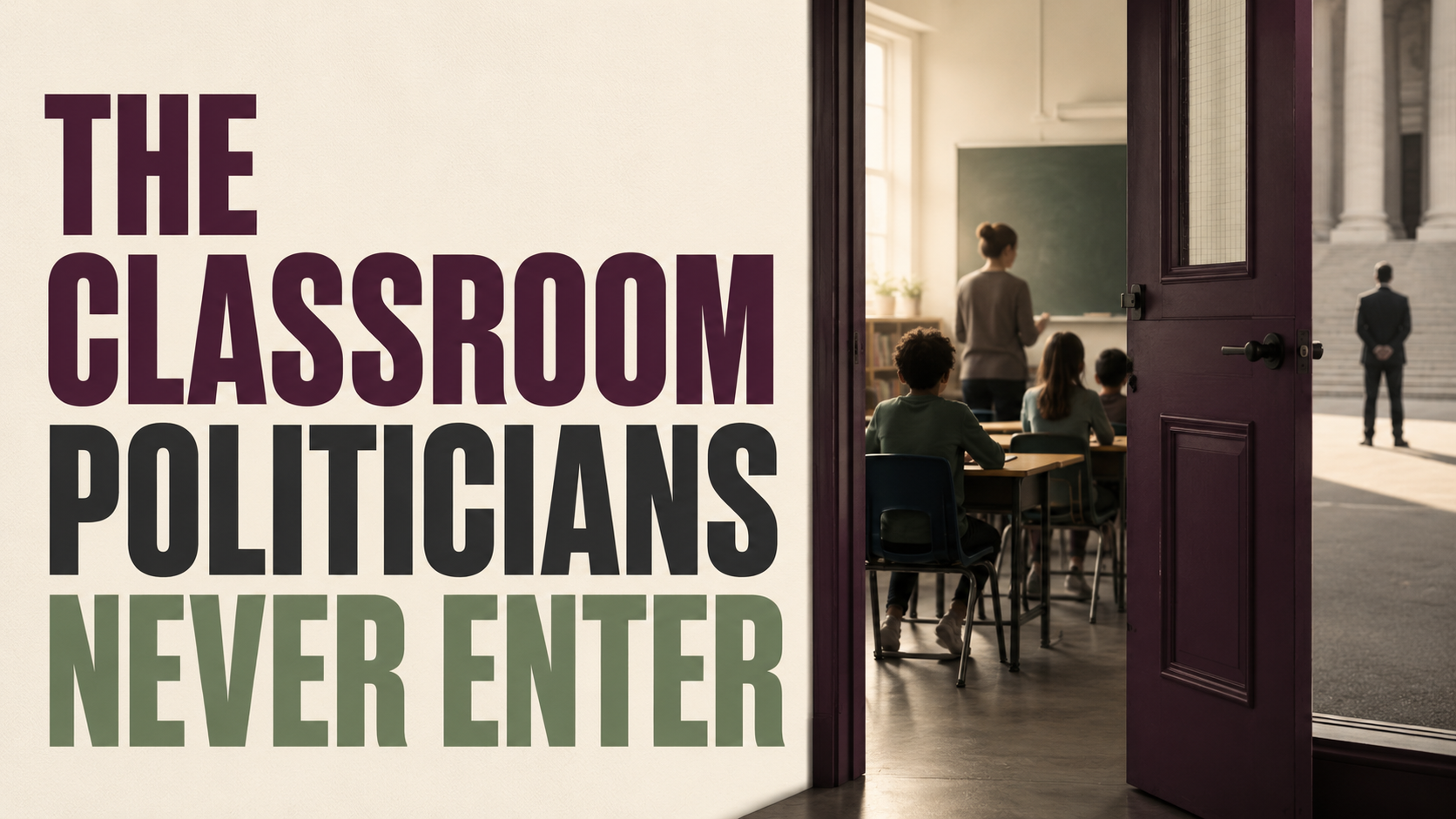
The deeper problem is that most school systems are designed by people who do not live inside the daily consequences of their decisions. A new policy is announced. A new curriculum is introduced. A new assessment demand appears. A new reporting format lands on the desk. The people at the top call it reform. The teacher in the classroom experiences it as another layer of noise added to an already overloaded day.
If schools were designed by teachers, the first thing that would change is not the colour of the buildings, the slogan on the wall, or the number of devices in the classroom. The first thing that would change is the operating logic of school itself. Teachers would ask a brutally simple question before approving anything: does this help learning, or does it only help adults look busy?
That question would kill many sacred cows. It would challenge the belief that longer school days automatically mean better learning. It would challenge the obsession with coverage. It would challenge curriculum documents that look impressive in meetings but collapse when placed in front of thirty restless children on a humid Tuesday afternoon. Teachers know that school is not a spreadsheet. School is a living room of minds, moods, mistakes, relationships, attention, memory, resistance, curiosity, fatigue, and possibility.
Politicians often design schools for visibility. Teachers would design schools for reality. That difference alone would change almost everything.
The timetable would be built around attention, not administrative convenience
One of the quietest failures of modern schooling is the way time is treated. The timetable often looks neat from an administrative angle, but the classroom experience can be chaotic. A child moves from mathematics to reading to science to a language lesson to a test to homework correction with barely enough mental space to breathe. Adults call it structure. Children experience it as cognitive traffic.
Teachers would design the school day differently because they see attention rise and fall in real time. They know the class that learns beautifully at 8:30 may become foggy by 12:15. They know younger learners cannot be treated like miniature office workers. They know adolescents may sit physically present while their minds are still negotiating sleep, friendship drama, family stress, hunger, anxiety, or digital overstimulation.
A teacher-designed school would not worship the timetable as a sacred object. It would use the timetable as a learning tool. Harder cognitive tasks would be placed when students are most alert. Movement would not be treated as a reward after learning but as part of learning. Breaks would be designed, not squeezed in. Transition time would be respected instead of ignored. Deep work would have longer blocks. Practice would not be treated as leftover time after explanation.
A school timetable should not simply answer, “What subject comes next?” It should answer, “What kind of mental state does learning require now?”
This is where teachers would immediately outperform political design. Politicians often think in terms of national calendars, hours, targets, and public promises. Teachers think in terms of attention, stamina, readiness, and feedback. One produces a schedule. The other produces a rhythm.
The curriculum would stop pretending that coverage is learning
If teachers designed schools, curriculum would become lighter, sharper, and more honest. Not easier. Not shallow. Honest. Teachers know the difference between teaching many things and helping students understand important things. They know that a packed curriculum often creates the illusion of rigour while quietly destroying mastery.
In many schools, teachers are pushed to “finish the scheme” even when half the class is still standing outside the door of understanding. A topic is introduced on Monday, rushed on Tuesday, tested on Friday, forgotten by the next month, and recorded as taught. Everyone moves on. The document looks complete. The child is not complete.
A teacher-designed curriculum would protect depth. It would identify what students must truly master, what they should experience, and what can be explored without pretending everything deserves the same weight. It would leave room for re-teaching because teachers know misunderstanding is not a disruption to learning; it is part of learning. It would allow time for students to practise, fail, receive feedback, correct, and try again.
This kind of curriculum would also respect local classroom intelligence. Teachers would have permission to adapt examples, texts, tasks, and projects to the learners in front of them. A teacher teaching fractions to children who struggle with division would not be forced to pretend readiness exists because the calendar says so. A literature teacher would not rush through a powerful text simply because the pacing guide is hungry. A science teacher would have space to let students investigate instead of memorising definitions like passengers reciting a safety card they do not understand.
Teacher-designed schools would still have standards. They would simply stop confusing standards with speed.
Assessment would become a diagnostic tool, not a public relations machine
Teachers would redesign assessment because they are the ones who suffer when assessment is abused. They see what happens when students learn to fear tests more than they value understanding. They see how grades can become labels, how rankings can become identities, and how exam preparation can swallow the broader purpose of education.
In a teacher-designed school, assessment would still matter deeply. But its purpose would shift. The question would not be, “How do we prove this school is performing?” The stronger question would be, “What does this evidence reveal about what students need next?” That one shift would change homework, marking, tests, report cards, parent conversations, and intervention.
Teachers would build more formative assessment into normal classroom life. Exit tickets. Quick retrieval checks. Low-stakes quizzes. Short written explanations. Peer discussion. Oral questioning. Mini-whiteboard responses. Error analysis. Student reflection. These are not fashionable techniques. They are classroom instruments. They help the teacher see the learning while it is still alive enough to be corrected.
- Instead of one big test after three weeks, teachers would use smaller checks throughout the learning journey.
- Instead of marking everything heavily, teachers would focus feedback on the exact skill being developed.
- Instead of ranking students publicly, teachers would track progress against clear learning goals.
- Instead of using exams to create fear, teachers would use assessment to build memory, confidence, and correction habits.
This would also change reporting. Parents would not only receive grades. They would receive clearer information: what the child can do, where the child is stuck, what support is needed, and what the next step should be. School leaders would not only ask for scores. They would ask what the scores mean and what instructional response follows.
A school designed by teachers would understand that assessment is not the end of teaching. It is one of teaching’s most powerful mirrors.
Teacher time would be treated as school infrastructure
Many school systems behave as if teacher time is elastic. Teach the lessons. Mark the books. Prepare the resources. Attend the meeting. Call the parent. Update the platform. Submit the report. Differentiate the tasks. Manage behaviour. Document the intervention. Smile during inspection. Then go home and plan tomorrow.
If teachers designed schools, this fiction would end. Planning time would be built into the structure of the week. Collaboration would not be an occasional luxury. It would be part of the school’s engine. Teachers would not be expected to produce excellent learning experiences on exhausted scraps of time.
A teacher-designed school would protect three kinds of professional time. First, individual preparation time, where teachers can think clearly, design lessons, review student work, and adjust instruction. Second, collaborative planning time, where teachers can build shared resources, examine student misconceptions, and strengthen consistency across classes. Third, development time, where teachers study practice, not just attend motivational workshops.
This would dramatically change staff meetings. Teachers would not sit through endless announcements that could have been written in a memo. Meetings would become working rooms. A department meeting might focus on why students are struggling with inference. A primary team might compare writing samples and agree on the next teaching move. A leadership meeting might study behaviour data and redesign routines, not simply complain that children are becoming difficult.
Teacher time is not an expense to be squeezed. It is the hidden infrastructure of school quality. When that infrastructure is neglected, everything else starts cracking: lesson design, feedback, morale, classroom management, parent communication, and student progress.
Behaviour would be understood before it is punished
A teacher-designed school would not be permissive. That is a lazy misunderstanding. Experienced teachers know that children need boundaries. They also know that punishment without understanding often creates compliance without growth, silence without safety, and fear without responsibility.
Teachers would design behaviour systems that begin before misbehaviour happens. Clear routines. Predictable transitions. Strong relationships. Calm correction. Consistent expectations. Physical classroom layout. Emotional safety. Restorative conversations. Meaningful consequences. These are not soft ideas. They are the engineering of order.
Many behaviour problems are worsened by poor school design. Crowded timetables, unclear routines, inconsistent adults, public shaming, weak supervision, boring instruction, and unregulated transitions all create the conditions for disruption. Then the child is blamed as if the system had no role. Teachers see this clearly because they operate at the point where policy meets the nervous system of a child.
- They would teach routines explicitly instead of assuming students already know how to behave in each learning situation.
- They would train staff in calm correction so discipline does not depend on volume, mood, or personality.
- They would create repair processes so students learn responsibility after harm, not just fear after punishment.
- They would study patterns such as when disruption happens, where it happens, and which structures are failing.
A teacher-designed school would still have consequences. But consequences would sit inside a wider system of prevention, instruction, support, and repair. The aim would not be to win power battles with children. The aim would be to build classrooms where learning is protected and dignity is not destroyed.
Leadership would become closer to the classroom
If schools were designed by teachers, leadership would not disappear. It would become more intelligent. The best teachers do not want leaderless schools. They want leaders who understand the classroom deeply enough to make decisions that help instead of harm.
Teacher-designed leadership would spend less time performing authority and more time building instructional conditions. Leaders would observe lessons not as fault-finders but as learning detectives. They would ask better questions. What is the task demanding from students? Where are students getting stuck? What kind of feedback is moving learning forward? Are teachers overwhelmed by preventable system problems? What routines need to be redesigned across the school?
This kind of leadership would also change professional development. Instead of bringing in one-off training that gives teachers excitement for two days and no structure afterwards, schools would build development cycles. One focus at a time. Observe. Practise. Review evidence. Coach. Adjust. Repeat. That is how professional growth becomes culture, not event decoration.
Teachers would also have a formal voice in decision-making. Not symbolic committees that meet after decisions have already been made. Real design tables. Before a new policy is introduced, teachers would test its classroom impact. Before a new reporting demand is added, leaders would ask what it replaces. Before a new technology platform is purchased, teachers would examine whether it reduces workload or simply moves stress onto a screen.
This would create a different kind of school power. Not the power of hierarchy. The power of professional intelligence. The people closest to the learning would help shape the conditions for learning.
The real revolution would be respect for classroom reality
The world would not become perfect if teachers designed schools. Teachers are not saints. They can be biased, tired, inconsistent, resistant, political, brilliant, generous, and flawed like every other group of professionals. But they possess one advantage school reform often ignores: proximity. They are close to the child. Close to the task. Close to the confusion. Close to the parent pressure. Close to the emotional temperature of the room. Close to what actually happens after a policy document is printed.
That proximity matters. A teacher can tell when a curriculum is too crowded. A teacher can tell when a timetable is killing attention. A teacher can tell when assessment is producing fear instead of learning. A teacher can tell when a behaviour policy looks strong on paper but fails in the corridor. A teacher can tell when a school is asking for excellence while refusing to create the conditions for it.
This is why the future of school design cannot be left only to political ambition, market trends, or administrative neatness. Schools need leaders, policymakers, parents, researchers, and communities. But the design table is incomplete when classroom teachers are treated as implementers instead of architects.
The next time a school introduces a new policy, programme, timetable, assessment model, or behaviour system, the strongest question is not whether it sounds modern. The strongest question is whether a wise teacher, standing in front of real children on a real school day, would say: yes, this will help learning breathe.
That is the test. Everything else is noise with a letterhead.
For School Leaders
This week, audit one school routine through teacher eyes. Pick a timetable block, reporting task, behaviour process, or meeting structure and ask: does this improve learning or only consume energy? Next, run a 30-minute staff design conversation where teachers identify one policy that creates unnecessary workload and suggest a better version. Finally, turn one staff meeting into a practice clinic. Focus on a real classroom problem, such as weak transitions, poor retrieval, noisy starts, or shallow written responses. Let teachers examine examples, agree on one shared move, and test it for one week. School improvement becomes real when leadership moves closer to classroom evidence.
Frequently Asked Questions
What would schools look like if teachers designed them?↓
Schools designed by teachers would be more focused on learning, attention, feedback, routines, and child development. The curriculum would be less overloaded, assessment would be more diagnostic, and teachers would have more structured planning time. The school day would be designed around how students actually learn, not just what adults want to measure.
Why should teachers be involved in school design?↓
Teachers work closest to students and understand how policies behave in real classrooms. They see where curriculum, assessment, behaviour systems, and timetables succeed or fail. Their involvement helps schools avoid reforms that look good on paper but damage learning in practice.
Would teacher-designed schools have lower standards?↓
No. Teacher-designed schools would likely have clearer standards because teachers know the difference between real mastery and rushed coverage. They would focus on deeper understanding, better feedback, stronger routines, and more meaningful assessment.
How can school leaders include teachers in decision-making?↓
Leaders can create teacher design groups for curriculum, assessment, behaviour, timetable, and workload decisions. They should test new policies with teachers before implementation, gather classroom evidence, and remove old demands before adding new ones. Teacher voice must influence decisions, not simply decorate them.
What is the biggest problem with politician-designed education systems?↓
The biggest problem is distance from classroom reality. Political systems often prioritise visibility, targets, and short-term performance, while teachers deal with attention, behaviour, learning gaps, workload, and student wellbeing every day. That gap produces reforms that sound strong but feel broken in practice.
Free Weekly Newsletter
The Modern Teaching Brief
Every new article lands in your inbox the moment it is published.
Subscribe Free →