The Classroom Psychology I Wish I Had Known Earlier
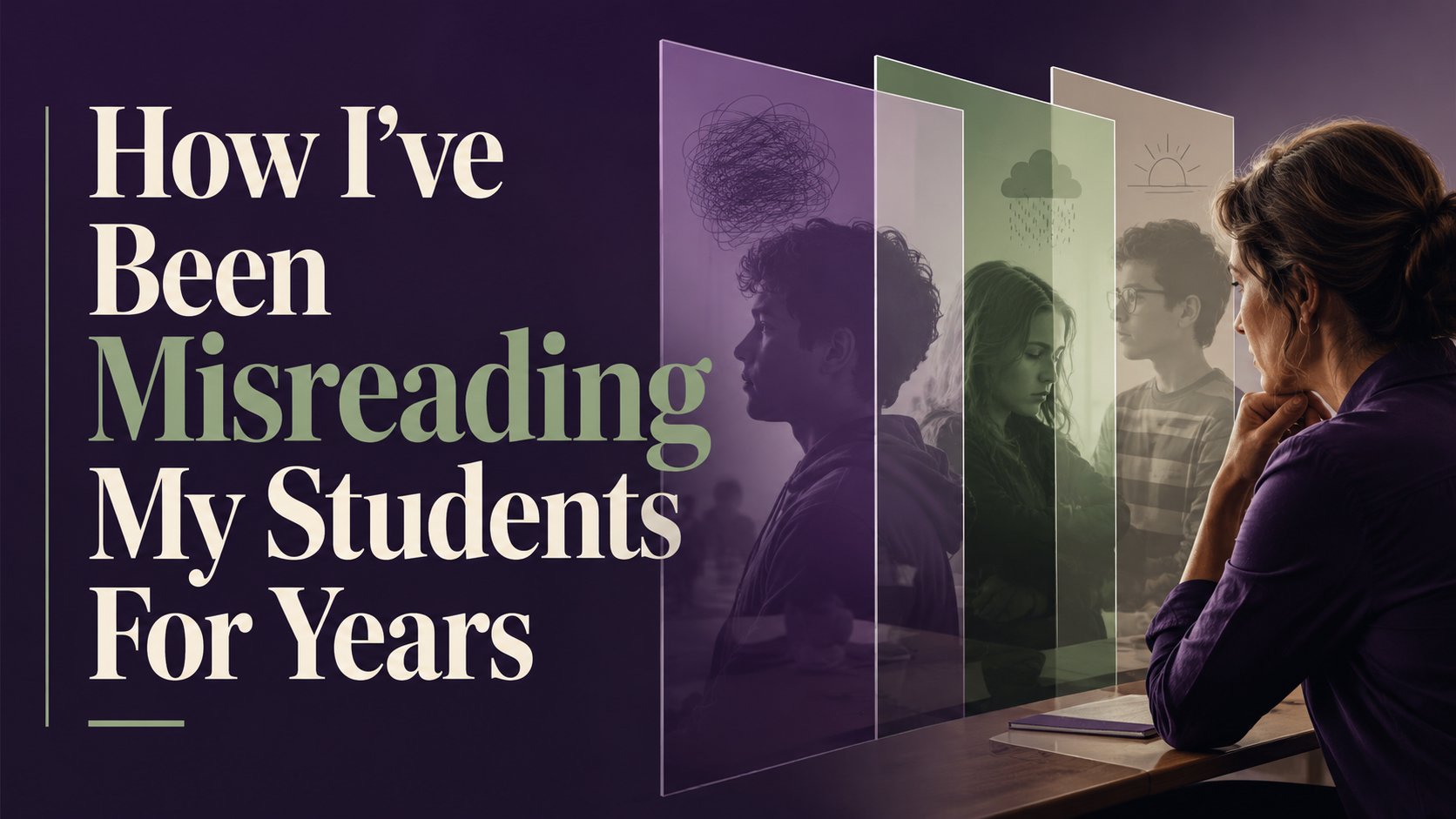
Quick Answer
Teachers often misread students because behaviour is easier to see than emotion, cognition, fear, shame, or unmet skill. Classroom psychology helps teachers interpret resistance, silence, attention-seeking, withdrawal, and disruption as signals instead of fixed character traits. When teachers respond to the cause beneath the behaviour, classroom management becomes calmer, fairer, and more effective.
Key Takeaways
- 1
A quiet student is not always attentive; silence can mean fear, confusion, shame, overload, or strategic avoidance.
- 2
A disruptive student may be protecting their image because failing publicly feels more dangerous than being punished.
- 3
“Lazy” students often lack clarity, confidence, skill, or emotional safety, not necessarily willingness.
- 4
Behaviour improves faster when teachers separate the student’s identity from the student’s current response.
- 5
Attention-seeking is often connection-seeking in a poorly packaged form.
- 6
Strong classroom systems reduce misreading because routines make behaviour patterns easier to interpret.
- 7
Teachers should correct behaviour without turning every correction into a judgement of character.
The problem was not that my students were hard to read. The problem was that I was reading them too quickly.
For years, I thought I understood what I was seeing in the classroom. The child who would not answer was shy. The child who kept interrupting was disrespectful. The child who stared out the window was unserious. The child who rushed through every task was careless. The child who argued after correction was proud. The child who did not submit work was lazy.
I had labels for almost everything. Some sounded professional. Some sounded harmless. Some sounded like normal staffroom language. But many of them were wrong. Not because the behaviours were imaginary, but because my interpretation was too shallow. I was reacting to the surface while the real story was happening underneath.
Experienced teachers know this tension well. You have thirty or forty learners in front of you. Time is tight. The lesson must move. The scheme must be covered. Behaviour must be managed. In that pressure, the brain looks for quick explanations. “He is stubborn.” “She does not care.” “They are not serious.” Those explanations feel useful because they are fast. But fast is not always accurate.
The classroom becomes dangerous when speed replaces understanding. Not physically dangerous in most cases, but psychologically dangerous. A student can be mislabelled for years. A teacher can keep applying the wrong strategy to the wrong problem. A school can build discipline systems around behaviour patterns it has never truly understood.
This is why classroom psychology should not be treated as a luxury topic for teachers who have extra time. It is the operating system behind classroom management, lesson architecture, discipline, feedback, correction, motivation, and teacher authority. When a teacher reads students wrongly, even good strategies can fail. When a teacher reads students better, correction becomes sharper, lessons become more humane, and authority becomes calmer.
Behaviour is communication, but it is not always honest communication
One of the most important lessons I wish I had learned earlier is this: students do not always show their real problem directly. They often show the behaviour that protects them from the real problem. This is why classroom psychology matters. It helps us see that behaviour is communication, but not always clear communication.
A child who does not understand the lesson may not raise a hand and say, “Sir, I am lost.” Instead, he may joke loudly. A student who fears embarrassment may not say, “Ma, I am scared of being wrong.” Instead, she may refuse to try. A learner who feels invisible may not say, “Please notice me.” Instead, he may keep calling out until the whole class turns around.
This does not mean every behaviour should be excused. A classroom cannot function if every disruption becomes a therapy session. But it does mean teachers need better interpretation before intervention. When we misread the signal, we choose the wrong response. We punish confusion. We shame fear. We confront insecurity as arrogance. We demand maturity from a child whose nervous system is still learning how to cope.
A student’s behaviour is often the visible solution they have created for an invisible problem they do not yet know how to name.
This single idea changes the way a teacher enters correction. Instead of seeing every behaviour as an attack on authority, the teacher begins to ask better internal questions. What is this student avoiding? What skill is missing? What emotion is too big? What pattern keeps repeating? What happens right before this behaviour appears?
Those questions do not make you soft. They make you accurate. Accuracy is stronger than anger because it targets the root instead of wrestling with the symptom. A teacher who understands this does not correct less. The teacher corrects better.
For example, “Stop being rude” attacks the child’s identity. “Lower your voice and repeat that respectfully” corrects the behaviour. “You are lazy” closes the door. “You have not started the task; begin with question one now” opens a path. “You like disturbing this class” creates a role. “You are calling out; write your answer first and I will come to you” redirects the energy.
The classroom shifts when teachers stop turning every behaviour into a character verdict. Students need correction, but they also need precision. The more precise the teacher is, the less emotional the correction becomes.
The quiet student may not be learning
Many teachers misread quietness as understanding. It is one of the most common classroom mistakes. A silent class feels peaceful. A student who does not disturb the lesson seems cooperative. A child who copies notes quietly looks responsible. But quietness is not always engagement. Sometimes it is fear wearing a neat uniform.
Some students become quiet because they are processing deeply. Some are naturally reserved. But others are quiet because they have learned that participation is risky. If they answer and get it wrong, classmates may laugh. If they ask a question, the teacher may say, “Were you not listening?” If they try and fail, their weakness becomes public. Silence becomes safer than learning.
This is why good teachers do not only ask, “Are they quiet?” They ask, “What kind of quiet is this?” There is focused quiet. There is confused quiet. There is defeated quiet. There is angry quiet. There is strategic quiet from a student who knows how to disappear in a full classroom.
A teacher can begin to read this better by watching for evidence of thinking, not just absence of noise. Is the student tracking the explanation? Can they explain the task in their own words? Do they start independently after instructions? Do their notes show understanding or copying? Do they avoid eye contact only during questioning? These details matter.
- Focused quiet usually comes with eye movement, note-making, task attempts, and response readiness.
- Confused quiet often comes with frozen posture, delayed starting, copying others, and repeated erasing.
- Defeated quiet may show up as head down, blank work, weak effort, or “I don’t know” before trying.
- Strategic quiet appears when a student has learned how to avoid attention while doing very little.
The mistake is treating all four types of quiet the same way. One student needs more challenge. Another needs a private check-in. Another needs the task broken down. Another needs accountability. Psychology does not remove teacher judgement. It sharpens it.
This is also where lesson architecture becomes powerful. A well-designed lesson does not depend only on who raises a hand. It creates multiple ways for students to show thinking: quick writes, pair rehearsal, mini-whiteboards, exit tickets, sentence starters, low-stakes checks, and short independent tasks. These structures help teachers see learning before the final test exposes failure.
A classroom with no checks for understanding is a classroom where many students can hide. The teacher may finish the lesson feeling successful because the class was quiet, but the books may later tell a different story. Silence is not proof of learning. Neat notes are not proof of understanding. Compliance is not the same as cognition.
The “lazy” student may be protecting themselves from failure
Few labels damage students faster than “lazy.” It is easy to use because it sounds like a complete explanation. The work was not done. The effort was low. The student did not revise. The book was empty. Lazy. Case closed.
But laziness is often the last page of a longer story. Some students stop trying because trying has become emotionally expensive. When a child has failed repeatedly, effort starts to feel dangerous. If they try hard and still fail, the failure feels personal. But if they do not try, they can tell themselves and others, “I could have done it if I wanted to.” Lack of effort becomes a shield.
This is especially common among students who want to appear confident in front of peers. They may joke through the lesson, dismiss the subject, mock serious students, or say the work is pointless. Underneath that performance is often a simple fear: “If I try and fail, people will know I am not as smart as I pretend to be.”
Teachers misread this because the behaviour looks unserious. But the psychology is often self-protection. The student is choosing social safety over academic risk. That does not make the behaviour acceptable, but it tells the teacher where to begin.
The best response is not a motivational speech. It is structured success. Give the student a task small enough to begin, clear enough to understand, and meaningful enough to build momentum. Replace public pressure with private entry points. Instead of saying, “You never do your work,” say, “Start with the first three questions. I will check those before you continue.”
This protects dignity while rebuilding effort. Once a student experiences success in small units, the fear of effort begins to reduce. Confidence is not built by shouting “believe in yourself” at children. It is built by designing tasks where effort produces visible progress.
This is one reason Classroom Future and Tomphonics Academy keep emphasising practical classroom tools, not just motivational talk. Teachers need scripts, checklists, routines, observation guides, correction frames, lesson planning structures, and behaviour reflection systems they can use in real classrooms with real children. If you need ready-to-use resources for classroom management, school systems, teacher growth, and school leadership, you can explore the Tomphonics Academy resource store here: Visit the Tomphonics Academy Store.
The right tool will not replace teacher wisdom, but it can reduce guesswork. A good checklist helps a teacher notice patterns. A strong correction script helps a teacher avoid emotional reactions. A lesson architecture template helps a teacher design entry points for reluctant learners. A classroom routine guide helps students know what to do before behaviour starts drifting.
Defiance is sometimes a fight for control
Every teacher knows the student who turns a small correction into a public battle. You ask them to stop talking. They ask, “Was I the only one talking?” You tell them to move seats. They drag the chair loudly. You correct their tone. They correct your wording. At first glance, it looks like disrespect, and sometimes it is. But many times, defiance is about control.
Children and teenagers do not always have control over much. They do not choose the timetable, the subjects, the pace, the seating plan, the teacher, the assessment, or the rules. For some students, especially those who feel powerless outside school, the classroom becomes the place where they test whether they can still control something. Even punishment can feel like control if they were the one who triggered it.
This is why public power struggles are so costly. When a teacher argues with a student in front of the class, the issue often shifts from behaviour to status. The student is no longer thinking about the instruction. They are thinking about saving face. The teacher is no longer simply correcting. The teacher is now defending authority in public. The class becomes the audience. Learning disappears.
Calm authority works differently. It refuses to turn correction into theatre. It uses fewer words, clearer choices, and private follow-up where possible. A calm teacher might say, “You have two choices. Join the task now or move to the reflection seat and complete it there. I will speak with you after the activity.” Then the teacher continues teaching.
Notice what happens here. The teacher does not beg. The teacher does not debate. The teacher does not insult. The teacher does not surrender the class to one child’s emotional weather. The student is given a boundary and a path back.
- Name the behaviour without attacking the student’s character.
- Give a clear instruction or limited choice.
- Return attention to the lesson quickly.
- Follow up privately when the emotional temperature has dropped.
Defiance grows when students discover that resistance can control the lesson. It reduces when the teacher’s response is calm, predictable, and emotionally uninteresting.
This does not mean the teacher becomes robotic. It means the teacher stops feeding the fire. Some students are skilled at pulling adults into emotional drama. They know the facial expression, the tone, the comment, or the delay that can make the teacher lose balance. Once the teacher loses balance, the student has shifted the lesson from learning to conflict.
The strongest teachers are not the loudest teachers. They are the most difficult to emotionally hijack. Their authority does not depend on volume. It depends on clarity, consistency, and follow-through.
Attention-seeking is often connection-seeking with poor strategy
Some students will do almost anything to be seen. They make jokes at the wrong time. They exaggerate reactions. They create side conversations. They volunteer answers they do not know. They provoke classmates. They become the classroom entertainment system. Teachers often call this attention-seeking as if that explains everything. But attention is not always the final need. Sometimes attention is the route to connection.
Human beings are wired to seek belonging. In classrooms, students quickly learn where they receive recognition. Some receive it through excellence. Some through obedience. Some through beauty, confidence, humour, athletic ability, or social dominance. Others discover that disruption works faster. If the only reliable way a child gets the room to respond is by misbehaving, misbehaviour becomes a social tool.
The teacher’s job is not to reward disruption. It is to create better routes for visibility. A student who constantly performs for attention needs structured responsibility, not endless scolding. Give them a role that serves the lesson. Let them distribute materials, lead a recap, manage a timer, read a question, or help demonstrate a task. But attach the role to behaviour expectations.
For example: “I need your voice today, but I need it inside the structure. You will lead the recap after this example. During the explanation, track the three key points.” This does two things. It acknowledges the student’s need for expression while placing it inside a learning frame.
When schools do not create positive identity routes, students create their own. The clown, the rebel, the silent genius, the victim, the bully, the helpless one, the “I don’t care” child — these are not just behaviours. They can become roles. Once a student is rewarded socially for a role, they may keep playing it even when it damages learning.
This is why identity matters. A teacher should not only correct what a student does wrong. A teacher should help the student see who they can become in the classroom community. “You are better than this” is not enough. Show them the better role and give them a way to practise it.
A child who is always corrected in front of peers may begin to believe that disruption is their only identity in the room. But a child who is given responsibility, privately coached, and publicly recognised for better choices can begin to build a new identity. That is not magic. It is repeated evidence. The student must see proof that a different version of themselves is possible in that classroom.
Good classroom psychology must become a system, not a private talent
Some teachers are naturally good at reading students. They notice emotional shifts quickly. They know when a child is anxious, when a group is restless, when a task is too hard, when a joke is becoming a disruption, and when silence is no longer productive. But schools cannot depend only on the instincts of gifted teachers. What one teacher understands privately, the school must learn to build into systems.
This is where school leaders come in. If every teacher interprets behaviour differently, students experience different schools inside the same building. One teacher sees confusion and reteaches. Another sees the same confusion and punishes. One teacher sees anxiety and provides an entry point. Another sees disrespect and escalates. The child becomes a different person depending on the adult in front of them.
A serious school needs shared language for behaviour. Staff should be able to discuss students beyond labels. Instead of saying, “That child is impossible,” teachers should be trained to ask, “What is the pattern? When does it happen? What happens before it? What skill might be missing? What response has worked before? What response makes it worse?”
This is not soft leadership. It is operational intelligence. When a school understands behaviour patterns, it can design better routines, better seating plans, better transitions, better interventions, better parent conversations, and better staff development.
- During lesson observations, leaders should look for how teachers interpret behaviour, not only how they control it.
- During staff meetings, teams should discuss recurring behaviour patterns with evidence, not emotion.
- During parent meetings, teachers should describe specific behaviours and triggers instead of attacking the child’s personality.
- During intervention planning, schools should separate academic gaps, emotional needs, attention patterns, and conduct issues.
This protects everyone. It protects the student from unfair labelling. It protects the teacher from emotional exhaustion. It protects the school from building discipline policies that punish symptoms while leaving causes untouched.
For school leaders who want to turn these ideas into real staff practice, the next step is not another long lecture during staff meeting. The next step is tools. Observation templates. Teacher reflection sheets. Behaviour tracking logs. Classroom routine systems. Lesson planning guides. Staff development resources. Practical materials that help teachers act differently on Monday morning, not just think differently during training.
You can find teacher and school growth resources from Tomphonics Academy here: Explore Practical Teacher and School Growth Resources. The goal is not to decorate your device with PDFs. The goal is to give your teachers the kind of structure that changes what happens inside classrooms.
The psychology I wish I had known earlier is not complicated, but it is humbling. Students are not always what they first appear to be. The unserious child may be afraid. The quiet child may be lost. The rude child may be guarding shame. The lazy child may have stopped believing effort works. The attention-seeker may be hungry for belonging. The high performer may be terrified of failure.
Once you see this, you cannot teach the same way again. You correct more carefully. You listen with more skill. You design lessons with more entry points. You stop turning every behaviour into a moral verdict. You become slower to label and faster to investigate.
That shift is not weakness. It is maturity. The child in front of you is not a problem to be conquered. The child is a pattern to be understood, guided, and rebuilt with structure strong enough to hold them while they learn who they can become.
What student behaviour have you misread before, only to understand later that something deeper was happening? Share your experience in the comment section. Your story may help another teacher correct with more wisdom, lead with more calmness, and see a child differently this week.
If this article gave you a new way to think about classroom behaviour, share it with a teacher, school leader, HOD, or parent who needs to read it. Better classrooms begin when better conversations spread.
Practical Example
In a Year 8 English lesson on persuasive writing, a teacher noticed that Daniel always became noisy when the class moved from discussion to independent writing. For weeks, she treated it as unserious behaviour and removed him from group work. One Tuesday, instead of correcting immediately, she watched the pattern. Daniel contributed well orally, but once asked to write, he distracted two boys beside him and joked about the task. The teacher quietly gave him a sentence starter, a three-point writing frame, and asked him to complete only the opening paragraph first. Ten minutes later, he had written more than he usually did in a full lesson. The issue was not that Daniel hated English. He could think verbally but froze when ideas had to become structured writing. Once the teacher corrected the missing bridge, the behaviour reduced.
For Teachers
This week, choose one student you have already labelled in your mind and observe them for three lessons without correcting your conclusion too quickly. Write down what happens before the behaviour, what the student gains from it, and what task demand appears at that moment. Then change one response: reduce public correction, give a smaller entry task, or offer a private check-in before the lesson begins. Finally, replace one character label with a behaviour statement. Instead of “She is rude,” write, “She challenges instructions during transitions.” That small shift will change the kind of solution you design.
For School Leaders
Start by adding a “behaviour interpretation” section to lesson observation notes: what did the teacher think the behaviour meant, and what evidence supported that interpretation? In your next staff meeting, take one recurring student behaviour and guide teachers to map triggers, patterns, current responses, and better alternatives. Then create a shared language list for staff: confusion, avoidance, attention-seeking, low confidence, poor self-regulation, skill gap, and boundary testing. When staff use the same language, discipline becomes less emotional and intervention becomes more precise.
Frequently Asked Questions
Why do teachers misread students?↓
Teachers misread students because classroom behaviour is visible, but the reason behind it is often hidden. A child may look lazy, rude, distracted, or careless when the real issue is fear, confusion, shame, weak skills, or lack of belonging. Better observation helps teachers respond to the cause, not just the behaviour.
What is classroom psychology?↓
Classroom psychology is the understanding of how students think, feel, respond, avoid, participate, and behave in learning environments. It helps teachers interpret behaviour, motivation, attention, confidence, peer influence, and emotional safety. It is practical because it shapes lesson design, correction, routines, and relationships.
How do I know if a student is lazy or struggling?↓
Look for patterns before you decide. A struggling student often avoids specific tasks, delays starting, copies others, gives up quickly, or performs better with scaffolding. A truly low-effort student may still understand the task but needs stronger accountability, clearer expectations, and consistent follow-through.
What should a teacher do when a student keeps seeking attention?↓
Do not reward disruption with long public reactions. Give the student positive visibility through structured roles, planned participation, and specific responsibility tied to behaviour expectations. The goal is to give the student a better route to recognition than interrupting the lesson.
How can school leaders help teachers understand student behaviour better?↓
School leaders can train staff to discuss behaviour using evidence instead of labels. Observation tools, behaviour pattern logs, coaching conversations, and shared intervention language help teachers respond consistently. This turns classroom psychology from individual instinct into a school-wide system.
Free Weekly Newsletter
The Modern Teaching Brief
Every new article lands in your inbox the moment it is published.
Subscribe Free →