How to Build Calm Authority Without Becoming an Angry Teacher
Quick Answer
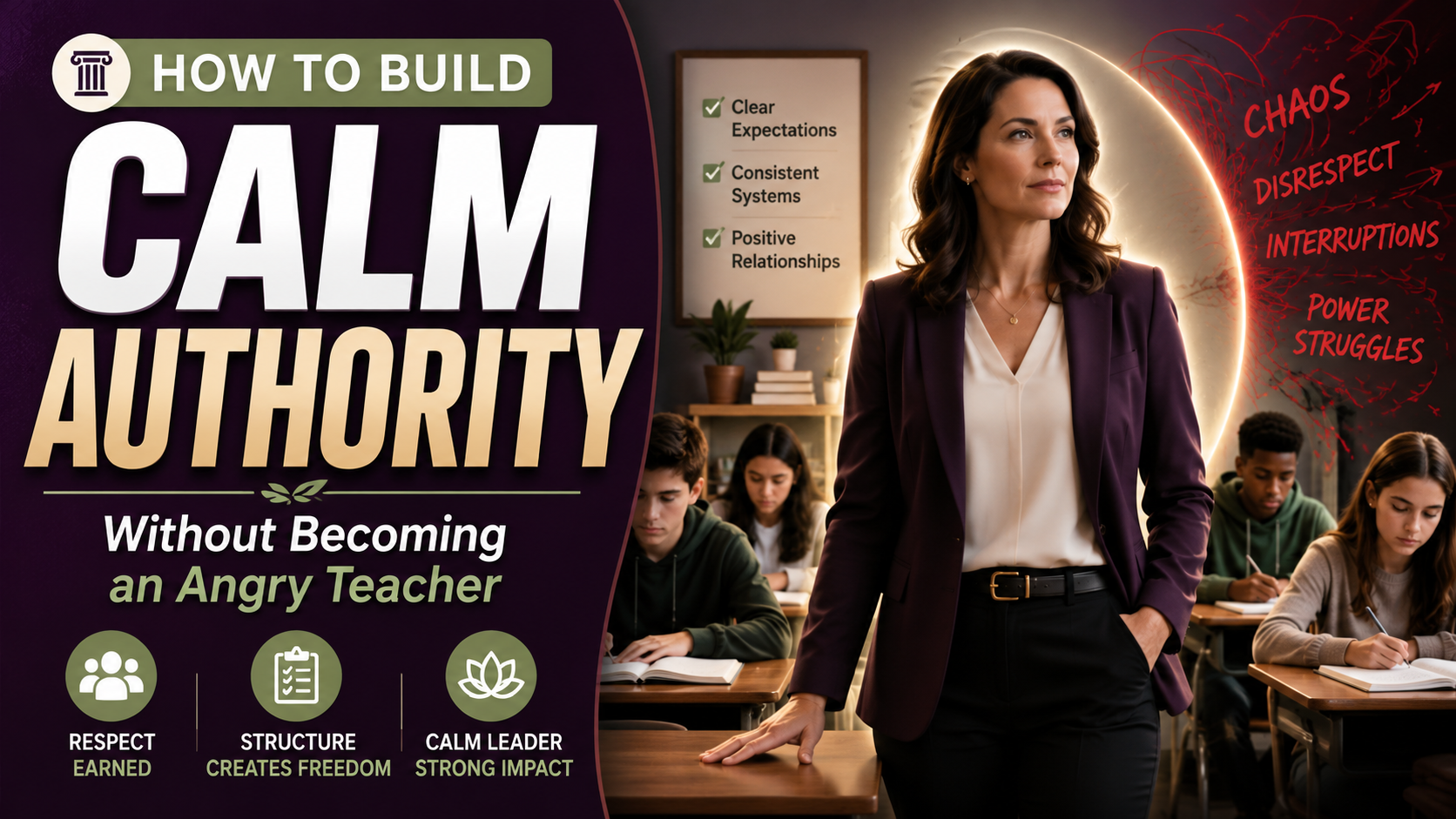
Calm authority is built through clear routines, consistent responses, strong lesson structure, and predictable consequences. An angry teacher reacts to disruption after it spreads; a calm authority prevents most disruption by making expectations visible, repeated, and easy to follow. The goal is not to control students with fear, but to lead the room with systems students can trust.
Key Takeaways
- 1
Volume is a last resort that produces short-term compliance and long-term erosion.
- 2
Calm authority communicates certainty and predictability — not anger.
- 3
Students are less likely to test limits when consequences are known and consistent.
- 4
Moving toward a student (proximity) replaces the need to project voice across the room.
- 5
Effective correction names the behavior, not the student's character.
The Real Problem Is Not Noise; It Is Unclear Authority
Many teachers do not become angry because they enjoy anger. They become angry because the classroom has started asking them the same question every day: “Who is really in charge here?” When routines are weak, instructions are vague, consequences are inconsistent, and lessons have too much dead space, the teacher is forced to manage behaviour with emotional energy. That is where anger enters. Not as a strategy, but as a survival tool.
The difficult truth is that many classrooms are not badly behaved because students are naturally impossible. They are badly behaved because the room has no reliable operating system. Students are not sure how to enter, when to speak, how to ask for help, what to do when they finish early, how correction works, or whether yesterday’s rule still applies today. In that kind of room, the teacher becomes the system. And when the teacher becomes the system, the teacher must constantly speak, warn, plead, repeat, threaten, explain, negotiate, and eventually explode.
Calm authority begins when the teacher stops trying to win every moment through personality and starts building a classroom that carries part of the leadership load. The teacher is still present. The teacher is still human. The teacher still corrects, redirects, praises, teaches, and decides. But the teacher is no longer dragging the class forward by force. The room has routines. The lesson has rhythm. Students know the boundaries. Correction is not a surprise attack. Consequences are not emotional revenge. The classroom starts to feel governed, not guessed.
Calm authority is not the absence of firmness. It is firmness delivered through structure instead of emotional escalation.
Why Anger Feels Powerful but Weakens Authority
Anger can create immediate silence. That is why teachers return to it. A raised voice can stop chatter, freeze movement, or shock students into attention. But silence created by anger is often temporary compliance, not real classroom order. The students may stop for a few minutes, but they have not learned the routine. They have not internalised the expectation. They have simply paused because the adult’s emotion has become bigger than theirs.
The danger is that anger trains the class to respond only when the teacher reaches a high emotional temperature. If the teacher says something calmly, students ignore it. If the teacher repeats it, they delay. If the teacher shouts, they obey. Over time, the class learns a hidden rule: real instructions only matter when the teacher is angry. That is how a teacher unintentionally builds a classroom where peace depends on pressure.
Anger also drains the teacher’s authority because it reveals loss of control. Students may fear an angry teacher, but they do not always trust one. Fear can make children hide mistakes, avoid questions, become defensive, or perform only when watched. In a learning environment, that matters. A classroom is not a military checkpoint. Students need boundaries, yes, but they also need enough psychological safety to think, attempt, fail, ask, correct themselves, and try again.
This does not mean teachers should become passive. Calm authority is not smiling through disrespect. It means the teacher’s response is designed before the offence. The teacher does not need to invent a punishment in anger because the consequence ladder already exists. The teacher does not need to argue because the expectation has already been taught. The teacher does not need to perform rage because the class already knows that calm words still carry weight.
Build the Classroom Operating System First
The teacher who wants calm authority must stop treating behaviour as a separate issue from classroom design. Behaviour is often the visible symptom of invisible system failure. A transition that takes five minutes creates noise. A task that is too easy creates boredom. A task that is too difficult creates shutdown. A vague instruction creates confusion. A poorly timed explanation creates restlessness. A teacher who waits until the room collapses before correcting has already surrendered the first layer of authority.
A classroom operating system is the set of routines, expectations, scripts, signals, and consequences that make the room predictable. Students should not need to guess what happens when they enter the class. They should not need a fresh lecture every time materials are shared. They should not need a loud warning before they know a boundary has been crossed. Good systems reduce the number of decisions the teacher must make in public under pressure.
Start with the moments where disorder repeats. These are usually the authority leaks. Look at the beginning of the lesson, transitions between activities, group work, independent practice, questioning time, correction moments, and the last five minutes. If the same problem appears every day, do not start by blaming the students. Ask: What system is missing here?
- If students talk while you give instructions, teach a listening routine and use a visible signal before speaking.
- If students waste time after finishing work, create an “after-task” menu that is always available.
- If students argue during correction, use a short correction script and move on without debate.
- If transitions become chaotic, rehearse the transition like an academic skill.
- If students keep asking the same procedural questions, display the steps before they begin.
Calm authority improves when the teacher removes repeated friction from the room. The fewer avoidable battles you fight, the more energy you have for actual teaching. Students begin to experience you not as a mood, but as a steady leader. That shift matters. A mood can be tested. A system is harder to negotiate with.
Teach Expectations Like Content, Not Announcements
One mistake teachers make is assuming that because they have said an expectation, students have learned it. But behaviour expectations need teaching, modelling, rehearsal, feedback, and repetition. A teacher would not teach fractions once and expect mastery forever. Yet many teachers say “listen when I am talking” in September and expect the class to perform it perfectly in March. That is not instruction. That is a wish.
If you want calm authority, teach your expectations like curriculum. Show students what the behaviour looks like, sounds like, and does not look like. Let them practise it. Correct the practice. Praise the standard when you see it. Return to it when the room slips. The goal is not to turn students into robots. The goal is to remove confusion. Confusion is one of the quiet engines of classroom disorder.
For example, instead of saying, “Stop being noisy when you enter,” teach an entry routine. Students enter, collect materials, sit down, begin the starter task, and write the date or learning question. The routine is displayed. The teacher greets students but does not negotiate the routine. If students enter noisily, the teacher does not launch into a speech about respect. The teacher resets the entry. “We are going to practise that again. Enter, collect, sit, start.” Short. Clear. Calm. Repeated.
This is where many teachers feel awkward. They think practising routines is childish or time-wasting. But the opposite is true. A few minutes invested in routine training can save hours of correction across the term. The classroom becomes calmer not because students magically mature, but because the room has learned how to move.
Use a Calm Correction Script
Angry teachers often talk too much during correction. They explain, warn, remind, complain, compare, threaten, ask rhetorical questions, and narrate their disappointment in front of the class. The problem is not that the teacher is wrong. The problem is that public over-talking turns correction into theatre. Once correction becomes theatre, students may perform for attention, defend their image, or pull classmates into the moment.
Calm authority uses correction that is brief, specific, and linked to the known expectation. A correction script protects the teacher from emotional drift. It also protects the student from public humiliation. The teacher does not need to win a speech contest. The teacher needs to return the student to the learning behaviour.
- Name the behaviour: “You are talking while I am giving the instruction.”
- Name the expectation: “During instruction, eyes forward, voice off, pen down.”
- Give the next action: “Turn forward now and track the example.”
- Move on: Do not stay there feeding the moment.
- Follow up privately if needed: especially when the behaviour repeats.
The power is in the ending. Many teachers begin correction well but lose authority by lingering. They keep looking at the student. They keep explaining. They wait for a perfect apology. They turn the whole class into witnesses. Calm authority corrects, confirms compliance, and returns to teaching. The message is clear: the lesson is bigger than the disruption.
When a student argues, the script becomes even more important. “This is not a debate. I will speak with you after the task. Right now, return to question three.” That line does two things. It refuses public negotiation and keeps the student connected to work. The teacher is not ignoring the issue. The teacher is choosing the right time and place to handle it.
Design Lessons That Reduce Behaviour Pressure
Some behaviour problems are really lesson design problems wearing a discipline costume. If students sit too long without thinking, they will create stimulation. If instructions are too long, attention will leak. If tasks have no clear success criteria, weaker students may hide, copy, joke, or disturb. If stronger students finish early with nothing meaningful to do, they may become the unofficial entertainment committee. Calm authority is easier when the lesson itself gives students something purposeful to do.
This is where lesson architecture becomes a behaviour strategy. A well-structured lesson has a clear beginning, a short input, active checks for understanding, guided practice, independent work, feedback loops, and a clean close. Students know the learning path. The teacher is not improvising every minute. The room has momentum.
Teachers should especially watch for “dead zones.” These are the moments where behaviour usually breaks: while the teacher searches for materials, writes too much on the board, handles one student’s question for too long, waits for everyone to finish, or transitions without a signal. Dead zones invite students to build their own agenda. Calm authority requires the teacher to design those gaps out of the lesson.
One practical approach is to plan a behaviour-aware lesson flow. Before the lesson, ask: Where are students most likely to drift? What will fast finishers do? How will I check understanding before independent work? What signal will I use to regain attention? What exact words will I use if students talk over instructions? These questions are not extra work. They are the work of running a classroom without constant emotional firefighting.
Become Predictable Without Becoming Cold
Some teachers fear that calm authority will make them less warm. They imagine that systems will remove personality, humour, care, flexibility, and human connection from the classroom. But strong systems do not kill warmth. They protect it. When routines carry the pressure, the teacher has more emotional space to notice students, encourage effort, listen well, and teach with presence.
The most trusted teachers are often not the softest or the strictest. They are the most predictable. Students know what will happen with them. They know kindness does not mean looseness. They know correction does not mean hatred. They know humour does not cancel boundaries. They know the teacher can smile and still hold the line. That combination builds real authority.
Predictability is not the same as rigidity. A calm teacher can still adjust. A student may need support. A class may need a reset. A lesson may need slowing down. But adjustment is different from emotional inconsistency. The teacher is not soft on Monday, furious on Tuesday, sarcastic on Wednesday, exhausted on Thursday, and pleading by Friday. The students meet the same adult presence every day.
The closing action is simple but demanding: choose one repeated classroom problem and build a system around it this week. Do not give another speech about it. Do not wait for the class to “behave better.” Design the routine, teach it, rehearse it, correct it calmly, and protect it until the room learns it. Angry teaching burns the teacher to heat the classroom. Calm authority builds a fire that can keep burning without destroying the person who lit it.
Practical Example
In a Year 7 English lesson on persuasive writing, the class always became noisy during the shift from teacher explanation to independent writing. Previously, the teacher would raise her voice, complain that they were wasting time, and spend three minutes trying to regain control. She changed the system. Before the task, she displayed three steps: “Open your book, write your argument sentence, underline your strongest reason.” Then she gave a 10-second countdown, stood still at the front, and used one line: “We move in silence because the first sentence needs full attention.” Two students began talking. She walked closer, said quietly, “Step one now,” and pointed to the board. No lecture. No drama. Within two minutes, most students were writing. By the end of the week, the transition had become faster because the class no longer had to guess what “start your work” meant.
For Teachers
Choose one recurring behaviour problem and turn it into a routine, not a complaint. Write the exact steps students should follow, display them, practise them, and correct calmly when they drift. Create one correction script you will use all week, such as: “That is not the expectation. The expectation is ____. Do ____ now.” Finally, plan your next three lessons with one question in mind: “Where will attention leak?” Prepare a signal, task, or transition structure before that moment arrives.
For School Leaders
Observe classrooms for system gaps, not just teacher personality. During learning walks, look at entry routines, transitions, instruction clarity, task design, and correction language. Choose one school-wide routine to standardise, such as lesson entry, attention signal, or end-of-lesson close. Then run a short staff development session where teachers practise correction scripts and transition routines together. Do not simply tell teachers to be firm; give them the operational tools that make firmness calm, consistent, and teachable across the school.
Frequently Asked Questions
How do teachers build authority without being aggressive?↓
By being predictable, consistent, and composed. Calm authority communicates certainty rather than threat. Students trust teachers whose responses are reliable — not those who are unpredictable.
How do you maintain authority in a difficult classroom?↓
Build routines before problems arise, use proximity instead of projection, name the behavior not the student, and ensure your consequences are known and consistently applied.
Why do some teachers lose classroom control?↓
Often because they rely on reactive, emotional responses — raised voices, ultimatums, public confrontations. These erode authority over time. Systems and composure are more durable.
Free Weekly Newsletter
The Modern Teaching Brief
Every new article lands in your inbox the moment it is published.
Subscribe Free →